Point-to-multipoint wireless
The engineering behind the links: path surveys, Fresnel zones, link budgets, band selection and sector planning.
Rural connectivity · Australia-wide
The house has internet. The shed, the dairy and the pump site do not. We build the wireless network that carries a connection across the property — and keeps the farm working on the days the internet does not.
The usual situation
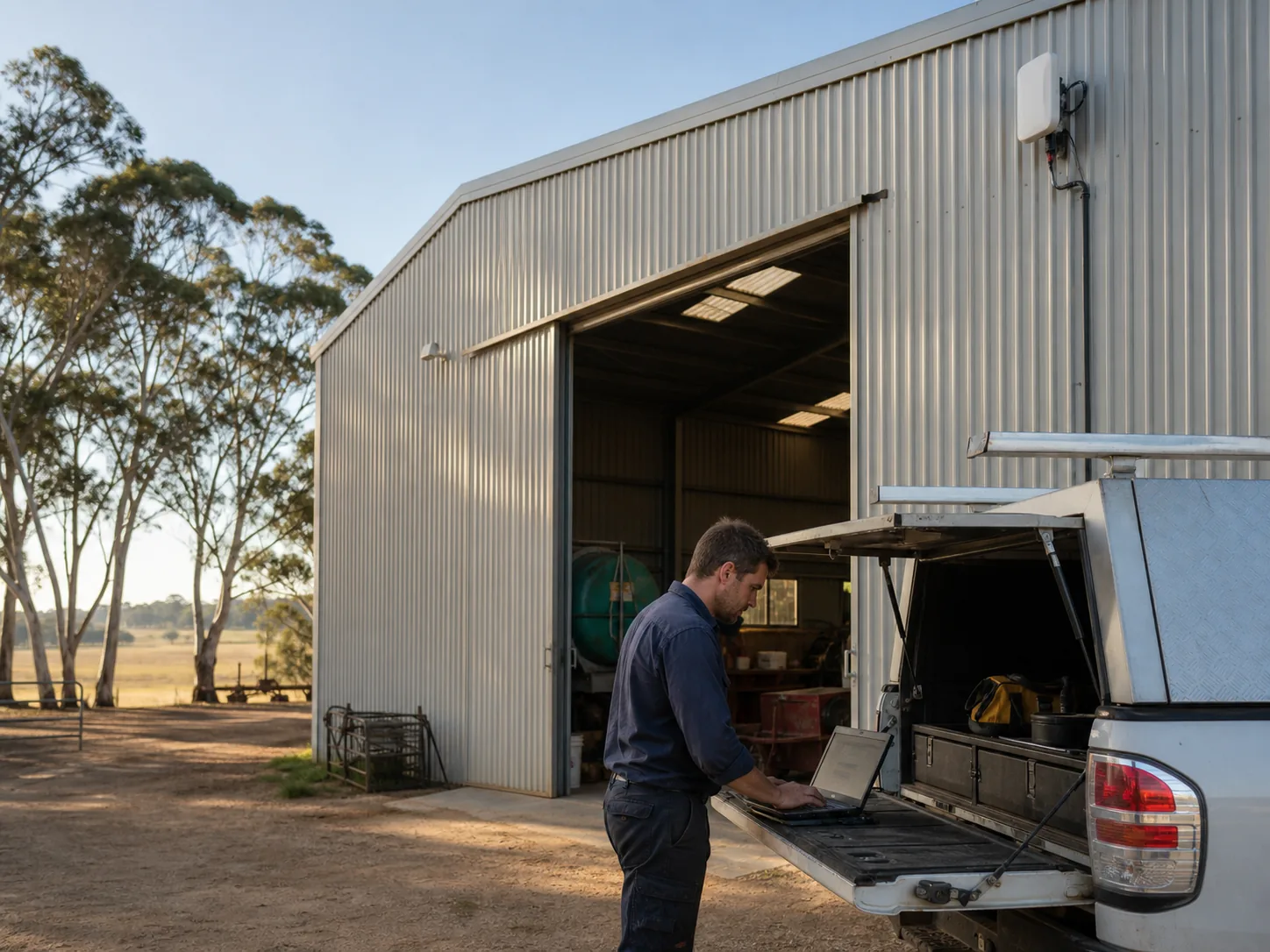
Most properties we visit have already solved the hard part. There is a decent connection at the homestead — satellite, fixed wireless or fibre to a nearby town — and inside the house it works fine. Walk two hundred metres to the machinery shed and there is nothing.
So the workshop has no way to look up a part. The dairy cannot get its data off the property. The camera on the front gate records to a card that nobody checks. Staff in the quarters use their own phone data. Somebody drives back to the house to send an invoice.
None of that is an internet problem. The internet arrived. What is missing is the network that carries it across the property — and that is a piece of infrastructure in its own right, no different in principle from the power or the water reticulation.
Two different jobs
Almost every frustrating conversation about rural connectivity comes from these two being treated as one thing. They are separate problems with separate solutions, and you need both.
Satellite, fixed wireless, fibre or mobile broadband — whatever reaches you where you are. This is the part most people have already sorted, and it is the part the market talks about constantly. It ends at one point on your property, usually the house.
Carrying that connection from the house to every shed, dairy, pump and camera that needs it, and giving each of those places usable Wi-Fi once it arrives. This is the part nobody sells you, it is where the value is, and it is what we build.
Buying a second satellite service for the shed solves one building and adds a bill. It does not connect the shed to the house, so the cameras still cannot reach the recorder and the office still cannot see the dairy. One good connection, properly distributed, beats three isolated ones.
What gets connected
The links themselves are point-to-multipoint wireless — one antenna at a high point on the property feeding many others. If you want the engineering behind them, that is covered on our point-to-multipoint wireless page. Here is what it means in practice.
Designed to keep running
Rural connections go down. Weather, outages, a satellite service having a bad afternoon — it happens, and it will keep happening. The question that matters is what stops when it does.
On a badly built farm network, everything stops, because every device was pointed at the internet even when it only needed to reach something two sheds away. On a properly built one, the local network carries on. Cameras keep recording to the recorder. Equipment keeps reporting to the system that collects it. The office keeps reaching the dairy. You lose email and the outside world, which is inconvenient, rather than losing the property's nervous system, which is not.
Where a property genuinely cannot afford to be offline, we add a second internet service on a different technology and set it to take over automatically. Two connections that fail in different ways are worth far more than one very good one.
Built for the paddock
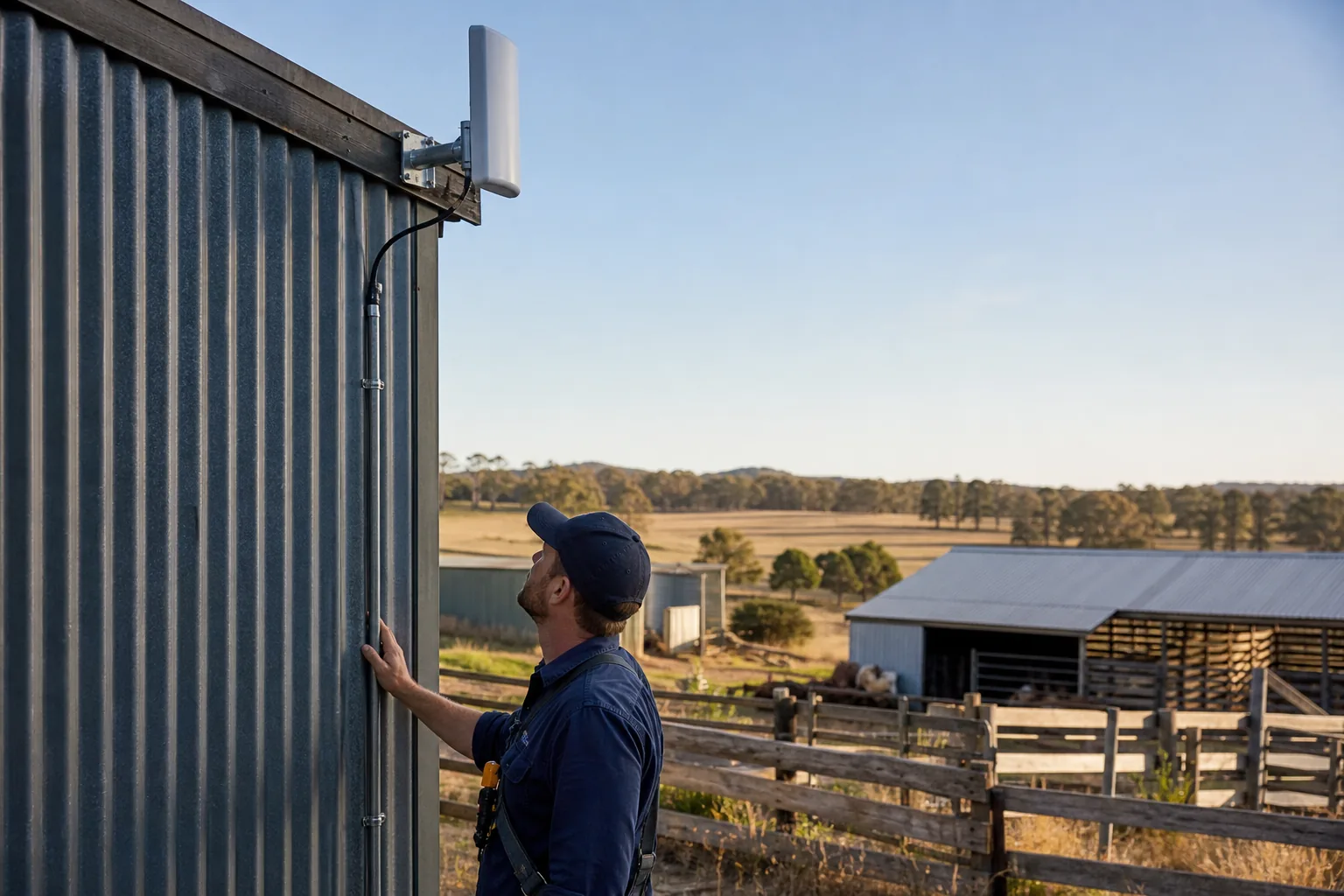
The networking part of a farm install is the straightforward part. What decides whether it is still working in five years is the physical build: whether the mount holds alignment in a westerly, whether the antenna is earthed, whether the enclosure keeps dust and damp out, and whether the solar was sized for a wet week or a sunny one.
We also think about who maintains it. Equipment bolted somewhere that needs a ladder, a spotter and good weather to reach is equipment that will not get looked at. Placement takes account of the person who has to service it later, which is often you.
After it is built
On a farm, the cost of a fault is not the repair — it is the trip. A link that drops at a pump site three kilometres out is a ute, a gate and half a morning, and that is before anyone knows whether the problem is the radio, the solar or the battery.
So we monitor the network continuously. Every link reports its signal level and throughput, every remote site reports whether it is still powered, and we alert on the slow decline as well as the sudden drop — an antenna drifting out of alignment after a westerly, a battery that is not quite recovering charge through a wet week, a camera that stopped uploading four days ago. Most of it we can see and often fix before anyone on the property notices.
You also get a dedicated IT manager who knows your property: which shed matters at harvest, which link feeds the dairy, and what was installed where. Not a queue that asks you to describe the paddock every time you call.
How it runs
Which buildings, what happens in each of them, where the cameras need to be, what is coming in the next few years. A network sized for today gets rebuilt sooner than one that left room.
We walk or drive the property and work out what can see what. This is where relay points get identified, mounting heights get settled, and any path that will not work gets ruled out before it costs you anything.
A plan showing where each antenna and access point goes, what each site gets, how power reaches it, and what it costs. Staged where it makes sense, so the sheds that matter most can be done first.
Mounting, alignment, earthing, power and configuration, then testing each link and each building rather than assuming. You get documentation showing what was installed where, and a support path when something needs attention.
FAQs
Yes, and it is one of the most common jobs we do. A small antenna at the house and another at the shed carry the connection across, then a normal access point puts Wi-Fi inside the shed. Distance is rarely the problem — what matters is whether the two points can see each other without trees or a ridge in the way.
No, and this is the most common misunderstanding we see. Starlink brings internet to wherever the dish is mounted, usually the house. It does nothing for the shed 800 metres away. You still need a farm network to distribute that connection across the property, which is the work described on this page.
Almost never, and paying for several connections is usually money wasted. One good connection at the homestead, distributed properly across the property by wireless links, gives every shed access to it. It is cheaper to run, easier to support, and it means one bill instead of five.
If it is designed properly, the farm keeps working. Cameras keep recording, the local network keeps talking to itself, and equipment that only needs to reach something else on the property carries on. We design for this deliberately, because rural connections do drop and an operation that stops entirely when they do has been built wrong.
Yes, and cameras are one of the main reasons properties get connected. They need more planning than people expect because they push video constantly, in the direction that has least capacity. We count the real camera load into the design rather than adding them afterwards and hoping.
Then we find another route. That usually means putting a relay point somewhere with a view of both ends — a hill, a silo, a tall shed — and hopping the signal through it. The path survey identifies this before you have spent anything on hardware, which is the entire point of doing one first.
If mains power is available at the shed, from there. If not, solar with a battery, sized for several overcast days in a row rather than for average sunshine — because the link matters most in exactly the weather that produces least sun. Remote pump and tank sites are routinely run this way.
We usually know before you do. Every link and solar-powered site reports continuously, so we see a dropped hop, a drifting antenna or a battery that is not recovering charge, and we alert on the slow decline as well as the sudden failure. Much of it is diagnosed and often resolved remotely, which saves the drive out to find out what broke.
Yes. Most properties keep the network under real-time monitoring with a dedicated IT manager who knows the site — which shed matters at harvest, which link feeds the dairy, and what was installed where. FPG is a working example: we designed and delivered their point-to-multipoint network with solar-powered remote sites, and we monitor it today.
Yes. SonarNext is based in Macquarie Park in Sydney and works on properties across metro and regional Australia. We are backed by Sonar Technologies International — 30+ years in Australian IT, ISO 9001 certified, 200+ customers — so a farm network here is supported the same way an enterprise site is.
Related
The engineering behind the links: path surveys, Fresnel zones, link budgets, band selection and sector planning.
The wider service, including multi-internet resilience and networks designed to survive an outage.
Antennas, access points, cameras, switches and enclosures sourced at trade pricing and configured before delivery.
Tell us what you are planning — a new site, a network that keeps dropping out, or IT that needs a safer pair of hands. We will come back with straight answers and a clear quote.