
Warehouse networking & wireless
The wider design-and-install service: industrial Wi-Fi, switching and cabling for warehouses of every temperature.
Cold chain connectivity · Australia-wide
Coolrooms and freezer warehouses are the hardest wireless environments most operators own. We design, install and validate Wi-Fi that keeps scanning through -25°C, door cycling and full racking — engineered for the cold, not adapted to it afterwards.
Why it fails
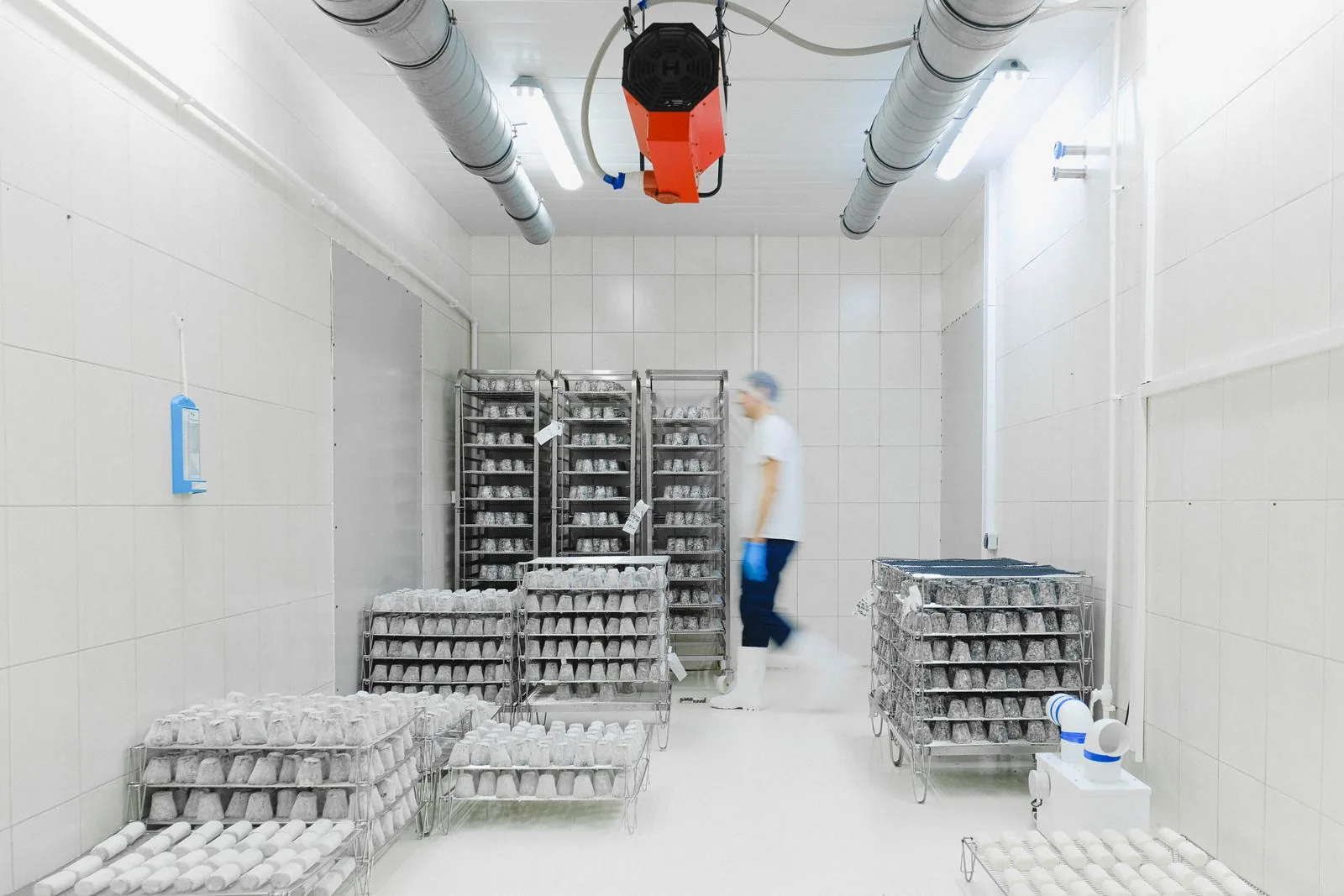
A freezer warehouse is close to a worst case for radio, and it is worth understanding why before anyone quotes you hardware. Start with the product. Most of what sits in a coolroom is largely water, and water absorbs 2.4 and 5 GHz signal aggressively — frozen or not. A full pallet of meat or produce is not an obstacle the signal bends around; it is a sponge the signal disappears into. An aisle that measures perfectly against empty racking can be a dead zone once stock arrives.
Then the room itself. Cold envelopes are built from insulated sandwich panels, usually with metal facings on both sides. To a radio wave, a box of joined metal-faced panels behaves like a Faraday cage: very little signal gets in from outside, and what is generated inside reflects around unpredictably. Add steel racking, steel mezzanines and stainless plant, and you have a room that both starves and scatters the signal at the same time.
Finally, nothing holds still. Rapid doors cycle hundreds of times a shift, and a doorway is often the only RF path into the room — so coverage genuinely changes with the door state. It is a different problem from ambient warehouse Wi-Fi, and it deserves a different design.
The hardware killer
Electronics tolerate stable cold better than most people expect. What they do not tolerate is the boundary between cold and ambient. Every time warm, humid air meets a surface that has been sitting at -25°C, moisture condenses on it — and inside any enclosure that is not properly sealed, that moisture ends up on circuit boards, connectors and antenna feeds. It freezes, thaws with the defrost cycle, and freezes again. Consumer-grade access points mounted inside a freezer typically die in months, and they fail intermittently first, which is worse.
The engineering answer is unglamorous and specific. Hardware inside the envelope needs to be temperature-rated for the room, or housed in a sealed enclosure — heated where the temperature demands it — so the electronics live in their own controlled microclimate. Cable entries matter as much as the box: a cable gland done wrong is a wick that carries moist air down the cable jacket and into the enclosure, and it will quietly defeat an otherwise sound installation. Every penetration gets glanded and sealed as if the room’s integrity depends on it, because it does.
The same logic applies to anything that moves across the boundary. A device or spare access point carried from the dock into the blast freezer sweats on the way back out. Where kit must cross the envelope, the design should say how, or the room will make its own arrangements.
Design choices
There are three broad ways to get signal into a cold envelope, and the right answer is different for a shallow chiller, a deep freezer aisle and a blast cell. Choosing between them is the core of cold storage wireless design.
Access points live in ambient conditions outside the envelope, with directional antennas aimed through doorways and openings. The electronics stay warm, dry and serviceable without anyone gowning up. It works well for shallower rooms and pick faces near doors — and stops working when the room is deep, the racking is dense, or the doorway spends most of the shift shut.
For deep freezer aisles there is often no substitute for radios in the room: temperature-rated access points or sealed, heated enclosures, positioned for the aisles rather than the ceiling. External antenna options earn their keep here — the enclosure protects the electronics while the antennas sit where the RF design needs them, aimed down the aisle at the height the scanners actually work.
Sometimes the clean design puts the access point inside and the cabling outside, which means going through an insulated panel. That is a construction decision, not just an IT one. A bad penetration is a thermal bridge that grows ice and wrecks the panel core, and it can void the panel warranty. We plan every penetration with the refrigeration contractor and panel installer, and seal it to their standard as well as ours.
Not one environment
A cold-chain site is usually four or five environments sharing one roof, and each one changes the wireless answer. Designing them as one zone is how freezers end up with the coverage the office deserved.
The extreme case: temperatures far below storage freezers, violent air movement and product loaded in dense batches. Often the right answer is minimal electronics inside and coverage engineered from the entry — every component that does go in must be rated for it.
Deep racked aisles at -18°C to -25°C running around the clock. This is where rated enclosures, external directional antennas and aisle-by-aisle design matter most, because product absorption and steel shadowing are both at their worst.
Above zero but persistently damp — condensation and washdown are the enemies rather than deep cold. Standard enterprise gear is still outside its comfort zone here; sealed housings and sensible placement usually get the job done.
Conventional warehouse Wi-Fi, but with a twist: this is where devices roam between temperature zones, so roaming behaviour across the cold boundary needs to be designed and tested, not assumed.
Small transition spaces where a scan often has to complete while both doors are shut. Easy to forget in the design, and the first place staff notice when it is.
Refrigeration plant is electrically noisy and yards mix weather with moving steel. Both sit on the edge of the cold-chain network and both are surveyed as part of the whole.
Coverage moves
Cold storage coverage is a moving target in a way ambient warehouses rarely are. Ice and frost accumulate on evaporators, ceilings and product between defrost cycles, and ice interacts with radio differently from clear air — a network validated the day after a defrost behaves differently a week later. Stock level swings the picture further: a freezer at 30% capacity and the same freezer wall-to-wall with frozen product are two different RF environments wearing the same floor plan.
Doors are the third variable. Where a doorway is a primary signal path, a rapid door cycling shut takes coverage with it — so a design that only works with the door open is a design that fails hundreds of times a day. The fix is not more power; it is a design that never depended on the door in the first place.
This is why we survey under production conditions and validate after installation rather than trusting the plan. Surveys are walked and validated in Ekahau, at device height, with doors and stock in their working state — and the design carries margin for the worst realistic case, not the day the room happened to be empty.
The device fleet
Plenty of "freezer Wi-Fi problems" turn out to be freezer device problems. Standard handheld batteries lose a large share of their capacity below freezing, so a device that lasts a full ambient shift dies mid-morning in the freezer. Touchscreens that need bare fingers do not get them from a picker in freezer gloves. And the classic: a scanner carried from -25°C out to the dock fogs instantly, then frosts, and cannot read a barcode until it dries — several times a shift, every shift.
Purpose-built cold-chain devices exist for all of this. We work with Zebra Technologies on rugged handhelds and scanners built for freezer duty — heated scan windows that stay clear through temperature transitions, batteries chemistry-rated for the cold, and screens and keys that work with gloves on. Specifying them is part of the same design conversation as the access points, because a device’s radio behaviour in the cold is part of the RF design, not an afterthought to it.
When we assess a cold-chain site we look at the fleet and the network together. It is the only way to stop the operations team and the IT team blaming each other’s equipment for the same symptom.
How we deliver
We survey the site as it runs — full racking, doors cycling, plant on. Our survey engineers are Ekahau certified, with certification current to Wi-Fi 7 (802.11be), and every zone in scope is measured at the height the devices work, from blast cell to loading dock.
Access point positions, antenna selection, enclosure and mounting requirements, and cabling routes — decided per zone, not copied across the site. We design on the platforms we install and support, including HPE Aruba Networking, Cisco, Ubiquiti and Fortinet, and the design states what each component must be rated for and why.
Cabling and containment through a cold envelope is planned with the people who own the envelope. Penetrations are agreed with the refrigeration contractor and panel installer before a hole is made, then sealed and glanded so the room’s thermal and moisture integrity survives the network installation.
After installation we walk the survey again and prove the design against the measurements, with doors shut and stock in place. You receive the validation data and documentation. SonarNext is backed by Sonar Technologies International — 30+ years in Australian IT, ISO 9001 certified, 200+ customers — and we service cold-chain sites across metro and regional Australia.
FAQs
Usually three things at once. Frozen product is mostly water, and water absorbs Wi-Fi signal aggressively at 2.4 and 5 GHz. The insulated panel walls have metal facings that keep outside signal out. And any access point inside is often consumer or standard commercial gear operating well below its rated temperature, so it fails or throttles. Each has a different fix, which is why guessing rarely works.
Not for long. Most enterprise access points are rated to around 0°C, and a freezer runs at -18°C to -25°C. Inside the envelope you need either temperature-rated hardware or a sealed, heated enclosure designed for the room’s temperature — and equally important, cable entries glanded correctly so moist air cannot migrate in and condense. Anything less dies in months, not years.
Often not. A common and reliable design mounts access points outside the insulated envelope and directs signal in through doorways and openings with directional antennas. It keeps electronics in ambient conditions and simplifies maintenance. Whether that covers your room depends on its depth, racking and door positions — which is exactly what a walked survey establishes before anyone drills a panel.
Because the room changed. Coverage measured in a part-empty room does not survive full racking, since frozen product absorbs signal. Ice and frost accumulate on surfaces between defrost cycles and change propagation. Doors that were open during commissioning are shut in production. A survey is only valid if it is walked under realistic stock and door conditions, then validated again after installation.
It may not be the network. Standard handheld batteries lose significant capacity below freezing, touchscreens misbehave with gloves, and a scanner carried from -25°C into a loading dock fogs and frosts over in seconds. Freezer-rated devices — such as Zebra’s cold-chain handhelds with heated scan windows and low-temperature batteries — exist for exactly this. We assess devices and network together, because the symptoms look identical.
Yes, but it is a construction decision as much as an IT one. Every penetration through an insulated panel is a potential thermal bridge and moisture path, and a bad one grows ice, rots the panel core and can void panel warranties. We plan penetrations with your refrigeration contractor and panel installer so each one is correctly located, sleeved, glanded and resealed.
The same way we survey any warehouse — walked, at device height, under production conditions — just dressed for it. Surveys are walked and validated in Ekahau, capturing signal, noise and interference in every aisle, blast cell and dock in scope, with doors and stock in their normal working state — because a freezer surveyed empty with the doors open tells you nothing about the room in production.
Yes. SonarNext is based in Macquarie Park in Sydney and works across metro and regional Australia. Regional cold stores, food processors and export packers are a large part of the cold-chain sector, and the engineering does not change with the postcode. We are backed by Sonar Technologies International — 30+ years in Australian IT, ISO 9001 certified, 200+ customers.
Related
The wider design-and-install service: industrial Wi-Fi, switching and cabling for warehouses of every temperature.
Already have a network that misbehaves? Start with a measured audit and a prioritised fix list you own.
Freezer-rated handhelds, rated enclosures and network hardware sourced through our vendor partnerships.
Tell us what you are planning — a new site, a network that keeps dropping out, or IT that needs a safer pair of hands. We will come back with straight answers and a clear quote.